

Rugby might look like organized chaos to a newcomer, players charging forward, tackling each other, then somehow passing the ball backward while kicking it forward. But beneath the physicality lies a beautifully structured game with clear rugby rules that govern every pass, tackle, and score. Whether you’re new to the sport or looking to deepen your understanding, this guide will walk you through everything from the pitch dimensions to the differences between Rugby Union and Rugby Sevens. By the end, you’ll grasp how two teams of athletes use strength, strategy, and continuous play to outscore their opponents. Let’s break down the rugby rules that make this one of the world’s most thrilling team sports.
How Rugby Is Played: The Basics Explained
At its core, rugby is a full-contact team sport in which two sides compete to carry, pass, and kick an oval ball across the opposition’s goal line. The objective? Score more points than your opponent within the allotted time.
Unlike many field sports, rugby rules demand that all passes by hand must travel backward or sideways. You can’t throw the ball forward to a teammate, that’s a knock-on or forward pass, and it stops play. Instead, teams advance up the field by running with the ball and using strategic kicks. Kicking is the only legal way to propel the ball forward, which is why you’ll often see players boot the ball downfield to gain territory or set up attacking plays.
When a player carrying the ball is tackled, brought to the ground by an opponent, they must release the ball immediately. Play doesn’t stop here: it becomes a contest at the breakdown. Players from both teams compete for possession in what’s called a ruck or maul, creating the continuous, flowing nature that defines rugby. There’s no blocking allowed, so ball carriers rely on support runners, well-timed passes, and quick decision-making to keep momentum alive.
This combination of backward passing, forward kicking, and non-stop action after tackles creates a unique rhythm. You’re constantly reading the game, reacting to space, and working as a unit to move the ball toward the try line.
The Rugby Pitch and Match Duration
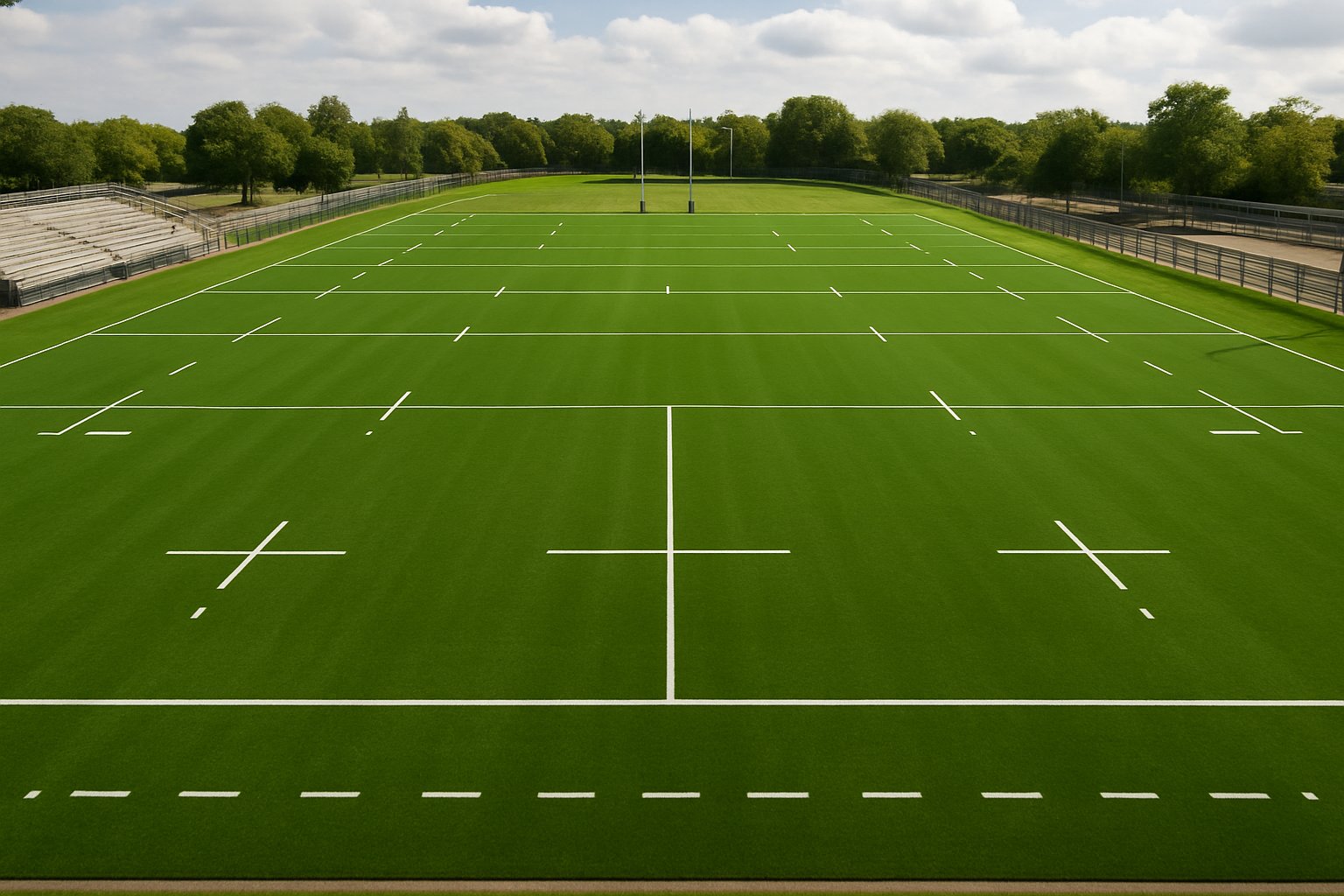
A rugby union pitch is rectangular and typically measures 100 meters long by 69 meters wide. At each end of the playing area, there’s an in-goal zone (often called the try zone or malt field) that’s usually 10 to 22 meters deep. The entire field, including these scoring zones, can stretch to around 120 meters in total length.
Goalposts stand at the center of each goal line, forming an H-shape. The two uprights are positioned 5.6 meters apart, connected by a horizontal crossbar set 3 meters above the ground. These posts are critical for conversions, penalty goals, and drop goals, all methods of scoring you’ll learn about shortly.
Key pitch markings include:
- Halfway line: divides the field into two halves: kick-offs and restarts happen here.
- 22-meter lines: mark a zone near each goal line: certain tactical kicks and restarts are governed by these lines.
- 10-meter lines (or dashed lines): indicate the minimum distance the ball must travel on kick-offs.
- Touchlines: the sidelines: if the ball or ball carrier crosses these, play restarts with a lineout.
As for time, a standard rugby union match lasts 80 minutes, split into two 40-minute halves with a short break (usually 10 minutes) at halftime. The clock can be paused for injuries or other stoppages, and referees often allow play to continue beyond the 80 minutes if the ball is still in action, only calling full-time when the ball goes dead or out of play. This ensures every match feels complete, even if it stretches a few minutes longer.
How to Score Points in Rugby

Understanding the rugby rules around scoring is essential because points come in several forms, each with different values and tactical implications.
The Try – Five Points
A try is the most coveted score in rugby and is worth five points. To score a try, your team must carry or kick the ball into the opponent’s in-goal area and ground it, that means touching the ball down on or behind the goal line with downward pressure. You can carry the ball over the line in your arms or kick it into the zone, but an attacking player must touch the stationary ball to the ground for the try to count. This is why you’ll see players diving dramatically to plant the ball: they’re ensuring clear contact with the turf.
The Conversion – Two Points
After a try, the scoring team gets a chance to add two extra points by kicking a conversion. The kicker places the ball on the ground (or on a tee) anywhere along an imaginary line perpendicular to where the try was scored. The goal is to kick the ball between the uprights and over the crossbar. If the try was scored near the corner, the conversion angle is tough: if it’s under the posts, it’s much easier. This is why attackers often try to ground the ball as centrally as possible.
The Penalty Goal – Three Points
When the opposing team commits a serious infringement, such as offside, a high tackle, or collapsing a scrum, the referee may award a penalty. Your team can choose to kick at goal for three points. The kicker takes a place kick from the spot of the penalty (or further back along the same line). If the ball sails between the posts and over the bar, you earn three points. Alternatively, teams can opt to kick for touch to gain territory or take a quick tap and keep play moving.
The Drop Goal – Three Points
A drop goal (sometimes called a field goal) is worth three points and can be attempted during open play. The kicker must drop the ball onto the ground and kick it on the half-volley, as it bounces up. If it clears the crossbar and goes between the uprights, the points are awarded. Drop goals are rare and thrilling, often used in tight matches when a team needs quick points and can’t risk losing possession.
Here’s a quick reference table:
|
Scoring Method |
Points | Description |
|---|---|---|
| Try | 5 |
Ground the ball in the opponent’s in-goal area |
|
Conversion |
2 | Kick through the posts after a try |
| Penalty Goal | 3 |
Place kick awarded after a penalty |
| Drop Goal | 3 | Kick in open play (ball dropped and kicked on the bounce) |
The team with the most points when the final whistle blows wins the match. Simple as that.
Player Positions and Team Structure
In rugby union, each team fields 15 players who are divided into two main groups: forwards and backs. Each group has distinct roles, but everyone must be ready to tackle, pass, and support play.
Forwards (Players 1-8)
Forwards are typically the bigger, stronger players who do the heavy lifting, literally. They contest scrums, win lineouts, and drive through rucks and mauls to secure or recycle possession. The eight forwards are further split into:
- Front row (1, 2, 3): Props and hooker: they form the first line in scrums and engage in close-quarter battles.
- Second row (4, 5): Locks: tall players who jump in lineouts and provide pushing power in scrums.
- Back row (6, 7, 8): Flankers and number eight: mobile forwards who tackle, carry the ball, and link with the backs.
Forwards are the workhorses who win possession and lay the platform for attacks.
Backs (Players 9-15)
Backs are usually faster and more agile, tasked with exploiting space, running attacking lines, and finishing scoring opportunities. The seven backs include:
- Scrum-half (9): The link between forwards and backs: feeds the scrum and distributes the ball quickly.
- Fly-half (10): The playmaker: kicks for territory, directs attacks, and often takes conversions and penalties.
- Centers (12, 13): Inside and outside centers who crash through or pass wide to create overlaps.
- Wings (11, 14): Speedsters positioned out wide to chase kicks and score tries in open space.
- Fullback (15): The last line of defense and a key counter-attacker: often joins the backline in attack and fields high kicks.
This structure of eight forwards and seven backs balances power with pace. Forwards secure the ball, and backs move it efficiently to score. But rugby rules allow any player to pass, tackle, or score, so you’ll see forwards making try-saving tackles and backs fighting in rucks. The beauty is in the teamwork, all 15 players working in sync.
Set Pieces: Scrums, Lineouts, and Restarts
Set pieces are controlled restarts that give both teams a chance to reset and compete for possession under the rugby rules. They’re tactical moments that can swing a match.
Scrums
A scrum is one of rugby’s most iconic images: eight forwards from each side bind together, crouch low, and push against each other to contest for the ball. Scrums are awarded after minor infringements like a forward pass, knock-on, or when the ball is unplayable in a ruck or maul.
Here’s how it works:
- The forwards pack down in three rows: front row, second row, and back row.
- The two packs engage, locking shoulders and heads.
- The scrum-half (player 9) from the team that didn’t commit the infringement feeds the ball into the tunnel between the two front rows.
- Each team’s hooker (player 2) tries to hook the ball back with their foot to their own side.
- The team that wins possession channels the ball to the back of the scrum, where the number eight or scrum-half picks it up and play resumes.
Scrums test strength, technique, and timing. Penalties can be awarded for collapsing, early engagement, or wheeling the scrum illegally.
Lineouts
A lineout occurs when the ball goes out of bounds over the touchline. Players from both teams line up perpendicular to the sideline, and the team that didn’t touch the ball last throws it back in.
Key points:
- The throw-in must be straight down the middle of the two lines.
- Players (usually the taller locks) are lifted by teammates to catch or tap the ball.
- The aim is to secure clean possession and quickly move the ball to the backs or forwards for the next phase.
Lineouts require precision, coordination, and coded calls so teammates know who’s jumping and where the ball is going.
Kick-Offs and Restarts
Matches begin and resume after halftime and after scores with a kick-off from the center of the halfway line. The kicker uses a drop kick, and the ball must travel at least 10 meters forward. The receiving team can catch it or let it bounce, then play continues. These restarts are crucial tactical moments, teams can kick deep to pin the opposition back, or kick short to contest possession and launch an immediate attack.
Mastering set pieces is essential under rugby rules because they’re opportunities to gain territory, dominate possession, and set the tempo of the game.
Key Rules and Infractions
Rugby has strict laws to keep play fair and safe. Understanding these rugby rules helps you follow the action and appreciate the discipline required.
Forward Pass and Knock-On
As mentioned, you cannot pass the ball forward with your hands. A forward pass results in a scrum to the opposing team at the point of the infringement. Similarly, if you drop the ball and it travels forward off your hands or arms, a knock-on, play stops and a scrum is awarded to the other side.
Offside
Offside rules prevent players from gaining an unfair advantage. In general play, you’re offside if you’re ahead of a teammate who last played the ball. Offside players can’t interfere with play, tackle opponents, or play the ball until they’re put onside (usually by retreating behind the ball or the teammate who played it).
At rucks and mauls, players must enter from behind the hindmost foot of their own team. At scrums, the offside line is the hindmost foot of the scrum. Breaking offside laws results in a penalty.
Tackling and Foul Play
Tackling is fundamental to rugby, but it must be safe and legal. You can only tackle the player with the ball, and contact must be below the shoulders. High tackles, hitting the neck or head, are dangerous and penalized harshly. Other forms of foul play include:
- Obstruction: blocking an opponent without the ball.
- Dangerous play: reckless tackles, stamping, or collapsing mauls/scrums.
- Not releasing: after a tackle, both the ball carrier and tackler must release immediately.
Penalties and Cards
Infringements are punished with penalties or free kicks. The non-offending team can kick for goal, kick to touch for territory, or tap and continue play.
For serious or repeated foul play, referees issue cards:
- Yellow card: The player is sent to the sin bin for 10 minutes (in 15s rugby), leaving their team a player short.
- Red card: The player is ejected for the rest of the match, and their team plays with 14 for the remainder.
Rugby rules place a strong emphasis on player safety, with dangerous conduct potentially leading to a red card and significant consequences for both the player and their team.
Advantage
One of rugby’s most elegant rules is advantage. If a team commits an infringement but the non-offending team gains a clear benefit (territory, possession, or a scoring opportunity), the referee lets play continue rather than stopping for a penalty. If the advantage doesn’t materialize, the referee brings play back for the penalty. This keeps the game flowing and rewards teams that play with awareness and pace.
Understanding these core rugby rules, forward passes, offside, tackling laws, and advantage, gives you the framework to watch and enjoy the sport at any level.
Rugby Union vs. Rugby Sevens: Understanding the Differences
While both formats share the same fundamental rugby rules around passing, tackling, and scoring, Rugby Union (also called fifteens) and Rugby Sevens offer very different experiences.
Rugby Union (Fifteens)
This is the traditional and most widely played format:
- 15 players per team on a full-size pitch.
- 80 minutes total: two 40-minute halves.
- More structured, with frequent set pieces like scrums and lineouts.
- Emphasizes forward power, tactical kicking, and phase play, teams may go through many phases of possession, probing for defensive weaknesses.
- Physicality and endurance are key: bigger forward packs dominate territory and possession.
Rugby Union is played at club, provincial, and international levels, with the Rugby World Cup as the sport’s pinnacle tournament held every four years.
Rugby Sevens
A faster, more explosive variant:
- 7 players per team on the same full-size pitch.
- 14 minutes total: two 7-minute halves.
- Fewer players mean far more open space, leading to high-scoring, end-to-end action.
- Set pieces are quicker and less frequent: the game emphasizes speed, fitness, and ball-handling skills.
- Sevens became an Olympic sport at the 2016 Rio Games, boosting its global profile.
Scoring is identical, tries are worth five points, conversions two, and penalty goals three, but because of the space and pace, tries come thick and fast. Penalty goals are rarely taken in Sevens: teams prefer to tap and attack.
Many Sevens players also compete in Rugby Union, using the faster format to sharpen fitness and decision-making. Reserve players from union squads often get game time in Sevens tournaments, honing their skills in a more run-intensive environment.
Quick Comparison Table
| Feature | Rugby Union (15s) | Rugby Sevens |
|---|---|---|
| Players per team | 15 | 7 |
| Match duration | 80 minutes (2 × 40) | 14 minutes (2 × 7) |
| Pitch size | Full rugby pitch | Same full pitch |
| Pace | Structured, tactical | Fast, high-scoring |
| Olympic sport? | No | Yes (since 2016) |
| Scoring system | Try (5), Conversion (2), Penalty (3), Drop goal (3) | Same |
Both formats demand teamwork, skill, and courage, but your choice between them comes down to whether you prefer grinding tactical battles or lightning-fast tries.
Conclusion
Rugby rules might seem complex at first glance, but they create a sport that’s dynamic, strategic, and deeply rewarding to watch and play. From the foundational law that you can only pass backward to the thrill of a last-minute drop goal, every rule serves to keep the game flowing, fair, and safe. You now understand how rugby is played, how points are scored, the roles of forwards and backs, the importance of set pieces, and the key infractions that shape the match.
Whether you’re drawn to the power and structure of 15-a-side Rugby Union or the electric pace of Rugby Sevens, rugby offers something for everyone. Its rich history and culture, rooted in respect, teamwork, and toughness, make it more than just a game: it’s a global community. So grab a ball, watch a match, or join a local club. The rugby rules are your gateway to one of sport’s greatest adventures.
Frequently Asked Questions About Rugby Rules
What are the basic rugby rules for passing the ball?
In rugby, you can only pass the ball backward or sideways with your hands. Forward passes are not allowed and result in a scrum being awarded to the opposing team. Kicking is the only legal way to move the ball forward.
How many points is a try worth in rugby?
A try is worth five points and is the most valuable score in rugby. To score a try, your team must carry or kick the ball into the opponent’s in-goal area and ground it with downward pressure.
What is the difference between Rugby Union and Rugby Sevens?
Rugby Union has 15 players per team and lasts 80 minutes with two 40-minute halves. Rugby Sevens has only 7 players per team and lasts 14 minutes with two 7-minute halves, played on the same full-size pitch, resulting in faster, higher-scoring matches.
How long is a standard rugby match?
A standard rugby union match lasts 80 minutes total, consisting of two 40-minute halves with a 10-minute break at halftime. The clock may pause for injuries, and play can continue slightly beyond 80 minutes if the ball is still in action.
What happens when a player is tackled in rugby?
When a ball carrier is tackled and brought to the ground, they must release the ball immediately. Play continues as a ruck or maul forms, where players from both teams compete for possession without blocking, creating rugby’s continuous, flowing nature.
What is offside in rugby and how does it work?
In rugby, you’re offside if you’re ahead of a teammate who last played the ball. Offside players cannot interfere with play, tackle opponents, or touch the ball until being put onside by retreating behind the player who played it.


