

If you’ve ever sat down to watch rugby and thought, “Wasn’t this supposed to be 80 minutes ago?”, you’re not imagining things. A rugby game has a standard match time, but the total real-world viewing time can stretch well beyond what the scoreboard says.
In rugby union, the official answer is simple: a match lasts 80 minutes, split into two 40-minute halves. But rugby doesn’t behave like basketball or the NFL, where the final buzzer ends everything on the spot. The clock can stop for injuries, TMO reviews, and substitutions. And even when the clock hits 80, play may continue until the ball next goes dead.
That’s why understanding how long is a rugby game, means looking at more than just the headline number. You also need to know how halftime works, what delays play, and why formats like rugby sevens feel completely different. Let’s break it down so the next time you watch a match, the timing actually makes sense.
How Long A Standard Rugby Union Match Lasts
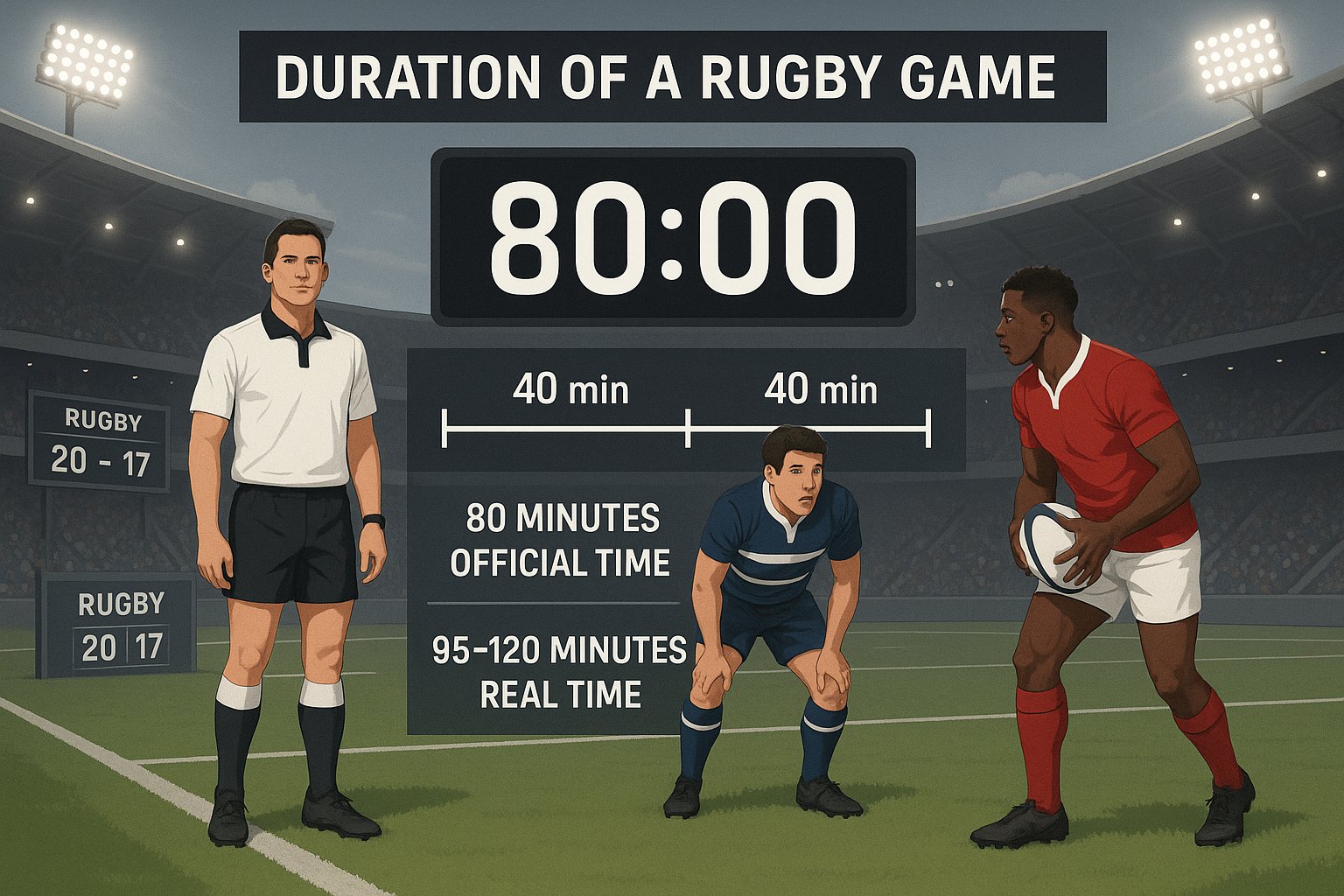
The standard length of a rugby union match is 80 minutes. That’s the official playing time, divided into:
- 40 minutes in the first half
- 40 minutes in the second half
This applies to most professional, international, and top-level club matches.
On paper, that sounds straightforward. In practice, it’s a little more nuanced.
Unlike some sports where the game ends the moment the clock expires, rugby has a live-flow rhythm. If the clock reaches 80 minutes and the ball is still in play, the referee does not always blow immediately. Play usually continues until the ball becomes dead, for example, when it goes into touch, a penalty is awarded and kicked out, or a team commits an infringement that stops play.
So if you’re asking how long is a rugby game, the best short answer is:
| Rugby format | Official match time | Typical total real time |
|---|---|---|
| Rugby Union | 80 minutes | 95–120 minutes |
That gap between official time and real elapsed time is what confuses new viewers. Rugby law allows time to be paused for important stoppages, so the full 80 minutes of playing time are preserved as much as possible.
At lower levels, youth rugby and some amateur competitions may use shorter halves. Match organizers can reduce the length of a game in non-international matches. But if you’re watching elite rugby union, you should expect the standard 80-minute structure.
How Halftime Works In Rugby
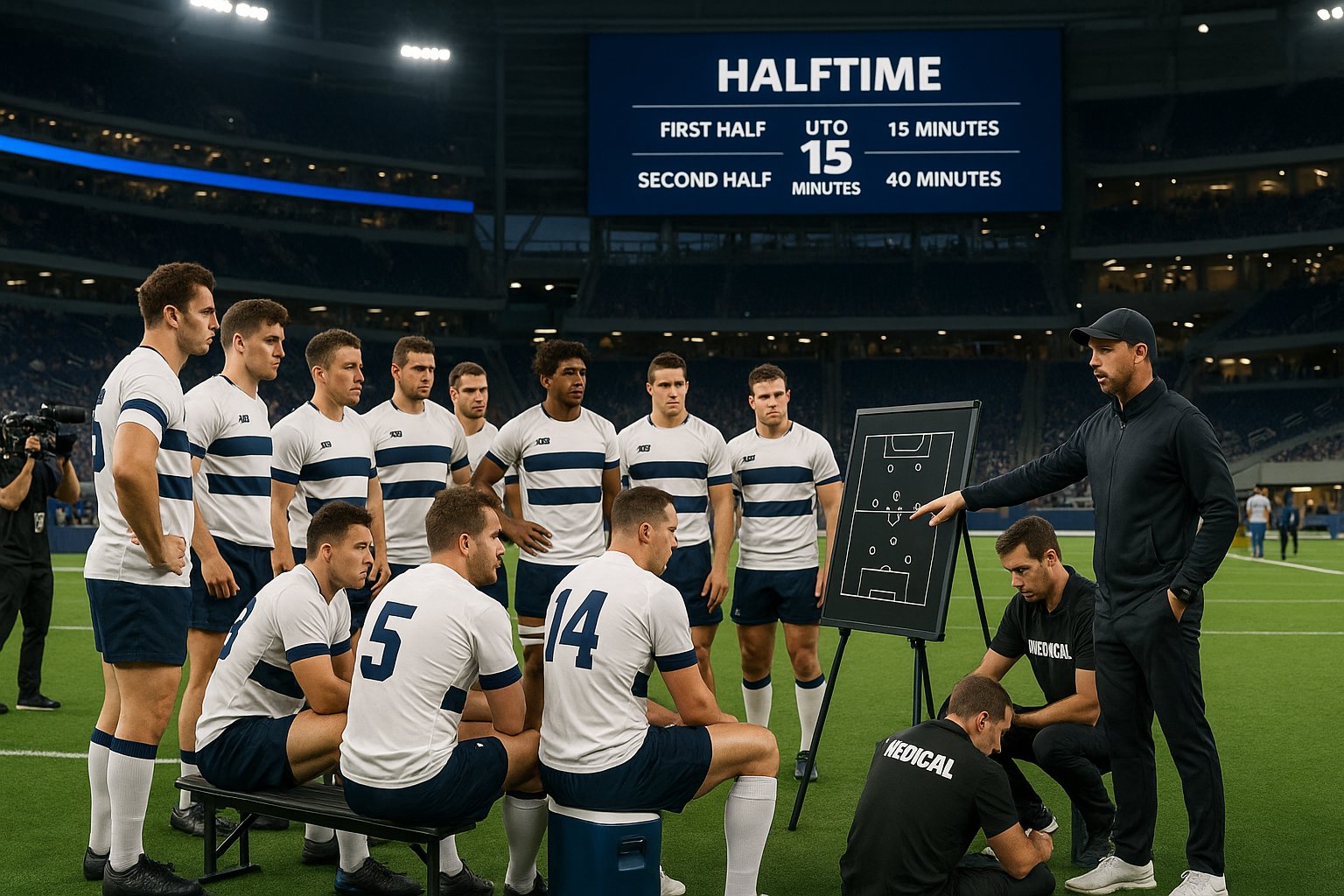
Halftime in rugby union lasts up to 15 minutes. That’s the maximum interval generally allowed by the laws, with the exact timing set by the match organizer or competition.
During halftime:
- players head to the locker room or sideline
- coaches make tactical adjustments
- medical staff assess knocks and fatigue
- broadcasters fit in analysis, highlights, and ads
- fans make the classic decision: snack run now, or risk missing the restart?
That 15-minute break matters because rugby is brutally physical. Players need a short reset, but not such a long one that momentum disappears.
What halftime is not
Halftime is not added to the 80 minutes of playing time. It sits between the two halves. So a standard rugby union match timeline looks like this:
- First half: 40 minutes
- Halftime: up to 15 minutes
- Second half: 40 minutes
If you’re budgeting your time as a viewer, halftime is one reason the full event lasts longer than 80 minutes.
Can halftime be shorter?
Yes. In some competitions, especially lower-level or local matches, the interval may be shorter than 15 minutes. But it cannot exceed the competition limit.
Here’s the simple version:
| Segment | Length |
|---|---|
| First half | 40 minutes |
| Halftime | Up to 15 minutes |
| Second half | 40 minutes |
So while people often focus on match length, halftime is part of why the total experience feels closer to a two-hour block than a neat 80-minute package.
What Can Make A Rugby Game Last Longer Than 80 Minutes
This is where rugby gets interesting. The official game time is 80 minutes, but the actual event can run 100 to 120 minutes depending on what happens.
Here are the main reasons a rugby game lasts longer than 80 minutes:
- Injuries that require on-field treatment
- TMO reviews for tries, foul play, or grounding decisions
- Substitutions and front-row changes
- Scrum resets when the scrum collapses or isn’t stable
- Lineout delays after kicks to touch
- Penalty kicks and conversions that take setup time
- General stoppages for foul play, warnings, or administrative issues
The biggest time-eaters
Some delays are quick. Others really chew up the clock.
A repeated scrum reset can feel like rugby’s version of “we’re doing this again?” The forwards pack down, it collapses, everybody stands up, the referee explains something sternly, and then the process restarts. Necessary? Yes. Fast? Not exactly.
TMO checks are another major factor. If there’s doubt over a try, dangerous tackle, or grounding, the referee may consult the Television Match Official. These pauses improve accuracy, but they can add several minutes.
Realistically, how long should you expect?
For most professional rugby union matches, a practical viewing estimate is:
- Minimum: about 95 minutes
- Common range: 100-110 minutes
- Longer matches: 115-120+ minutes if there are many stoppages or reviews
So if you’re planning to watch a full match, don’t schedule something important exactly 81 minutes later. Rugby has a habit of ignoring your calendar.
How Long Rugby Sevens And Olympic Rugby Matches Last
If rugby union is the full meal, rugby sevens is the espresso shot.
A standard rugby sevens match lasts just 14 minutes, split into:
- 7 minutes in the first half
- 2-minute halftime
- 7 minutes in the second half
That’s the format used in most sevens competitions, including the Olympic rugby tournament. So if you’re asking how long Olympic rugby matches last, the answer is usually 14 minutes total of playing time.
The shorter format exists for a reason: sevens tournaments often require teams to play multiple matches in a single day or across a compact schedule. With only seven players per side on the field, there’s more open space, more sprinting, and more chaos in the best possible way.
Why sevens feels faster than union
It’s not just shorter on paper. It also moves faster because:
- there are fewer players on the field
- restarts happen quickly
- possession changes can become instant scoring chances
- teams play with much more space to exploit
What about finals?
In some competitions, especially major sevens tournaments, a final can have longer halves than a standard sevens match. Organizers may extend the match length, though the common Olympic and tournament standard remains 14 minutes.
Here’s a quick snapshot:
| Format | Halves | Halftime | Total playing time |
|---|---|---|---|
| Rugby Union | 2 x 40 min | Up to 15 min | 80 min |
| Rugby Sevens | 2 x 7 min | 2 min | 14 min |
If you’re new to rugby and want a fast introduction, sevens is often the easiest entry point. It’s short, sharp, and there’s very little time to check your phone without missing a try.
Rugby Union Vs Rugby Sevens: The Biggest Timing Differences
Rugby union and rugby sevens share the same family tree, but their match timing creates two very different viewing experiences.
Side-by-side comparison
| Feature | Rugby Union | Rugby Sevens |
|---|---|---|
| Players per team on field | 15 | 7 |
| Match length | 80 minutes | 14 minutes |
| Halftime | Up to 15 minutes | 2 minutes |
| Typical event pacing | Tactical, physical, layered | Fast, open, high-scoring |
| Multiple matches in a day? | Usually no | Often yes |
The feel of the game
In union, time allows for territory battles, set-piece pressure, tactical kicking, and long defensive sequences. The game breathes differently. You can watch momentum build over ten phases and feel the tension rise.
In sevens, momentum doesn’t build slowly, it detonates. One missed tackle and a player might be under the posts in seconds.
Why the timing structure matters
The longer union format rewards depth, bench usage, forward dominance, and patience. The shorter sevens format rewards speed, recovery, and quick decision-making under fatigue.
If you’re choosing what to watch based on time alone:
- Watch union if you want the full strategic contest.
- Watch sevens if you want compact, high-speed rugby.
Neither is better. They just ask for different things from you as a viewer. One is a slow-cooked game plan. The other is rugby with the dial turned all the way up.
How Stoppage Time, Injury Time, And Extra Time Work
This is one of the most misunderstood parts of rugby.
Is there stoppage time or injury time in rugby?
Not in the same way as soccer. In rugby, the referee can stop the match clock for many interruptions, including:
- injuries
- substitutions
- TMO reviews
- disciplinary incidents
- other significant delays
Because the clock is often paused, rugby doesn’t usually use a separate visible block of “injury time” added on afterward in the same way soccer does.
Why does play continue after 80 minutes?
Because full-time in rugby isn’t always a hard wall. If time expires while the ball is still live, play can continue until the ball goes dead. That means a team still attacking may keep possession and run several more phases beyond 80:00.
This creates some of rugby’s most dramatic endings. You’ll see a trailing team desperately keep the ball alive for one last shot, while the leading team tries to force an error or get the ball into touch.
How extra time works
In knockout matches where a winner is required, a tied score can lead to extra time. A common format is:
- 2 periods of 10 minutes
- total extra time: 20 minutes
Competition rules can vary, so always check the tournament regulations. Some events may use other tiebreak methods if scores remain level.
Quick timing guide
| Situation | What happens |
|---|---|
| Injury or TMO review | Clock may stop |
| Clock hits 80:00 | Play may continue until ball is dead |
| Knockout match tied | Extra time may be played |
So yes, a rugby match can go beyond 80 minutes. But no, it’s not random chaos. Well, not timekeeping chaos anyway.
The Basic Rules That Help Match Time Make Sense
If you’re new to rugby, match time feels much easier to follow once you understand the game’s basic structure.
Rugby union is played by 15 players per team, with 30 players total on the field at kickoff. Broadly, those players are split into:
- 8 forwards
- 7 backs
The forwards do much of the close-contact work: scrums, rucks, mauls, and physical possession battles. The backs usually operate with more space and speed. This matters for timing because the type of play affects the game’s rhythm. A match full of set pieces and collisions naturally moves differently from one with open-field running.
The aim is simple: score more points than your opponent. You can do that through tries, conversions, penalty kicks, and drop goals.
And one more key idea: rugby is a flowing game. There are stoppages, yes, but the sport is built around contests for possession rather than constant discrete plays. That’s why the clock and the game state don’t always line up neatly for first-time viewers.
Scoring And Set Pieces That Affect The Flow Of A Match
Some of the biggest timing swings come from how points are scored and how play restarts.
Scoring methods:
- Try: 5 points
- Conversion: 2 points
- Penalty kick: 3 points
- Drop goal: 3 points
After a try, the scoring team gets a conversion attempt. That setup takes time. A penalty kick at goal also slows the pace, because the kicker must place the ball, step back, and take the shot within the allowed time.
Set pieces that affect flow:
- Scrums: can require resets if unstable
- Lineouts: form after the ball goes into touch
- Mauls and rucks: can produce longer passages before a whistle
If you know what a scrum, lineout, and conversion are doing to the match rhythm, the time side of rugby suddenly feels much less mysterious.
How Rugby Compares To Other Sports In Total Game Length
On paper, rugby union’s 80-minute match length puts it close to soccer. But in real elapsed time, it often lands somewhere between soccer and American football.
Here’s a useful comparison:
| Sport | Official game time | Typical real-world duration |
|---|---|---|
| Rugby Union | 80 min | 100–120 min |
| Soccer | 90 min | 105–120 min |
| Basketball (NBA) | 48 min | 2–2.5 hrs |
| American Football (NFL) | 60 min | 3+ hrs |
| Rugby Sevens | 14 min | 20–30 min |
What makes rugby feel different?
Rugby usually has fewer long commercial breaks than the NFL and fewer stop-start possessions than basketball. But it can still run long because of officiating reviews, injuries, and set-piece resets.
Compared with soccer, rugby’s official time is shorter, yet the actual viewing window can be very similar. The difference is in how the time is managed. Soccer adds time at the end of each half. Rugby often stops the clock during major interruptions and then lets live play continue beyond the 80-minute mark if the ball hasn’t gone dead.
If you’re planning your evening a good rule of thumb is this:
- Rugby union: set aside about 2 hours
- Big test match or stop-start contest: maybe 2 hours or a bit more
- Rugby sevens: much shorter, often under 30 minutes total
So no, rugby isn’t the longest sport to watch. But it’s also not an 80-minute in-and-out experience unless the match moves unusually cleanly.
Conclusion
So, how long is a rugby game? In standard rugby union, it’s 80 minutes, made up of two 40-minute halves with halftime of up to 15 minutes. But the real total can stretch to 100-120 minutes once you factor in stoppages, TMO reviews, injuries, set pieces, and the fact that play can continue after 80 minutes until the ball goes dead.
If you’re watching rugby sevens or Olympic rugby, the format is much shorter at 14 minutes total.
The easiest way to remember it: rugby has a fixed match structure, but a flexible finish. And honestly, that unpredictability is part of the fun.
Frequently Asked Questions About Rugby Game Duration
How long is a rugby game?
A standard rugby union match lasts 80 minutes, divided into two 40-minute halves. This is the official playing time used in professional and international matches.
Why do rugby games often last longer than 80 minutes?
Rugby games often exceed 80 minutes due to stoppages like injuries, substitutions, TMO reviews, scrum resets, and penalty kicks, as well as play continuing after 80 minutes until the ball goes dead.
What is halftime duration in a rugby match?
Halftime in rugby union lasts up to 15 minutes, allowing players to rest and coaches to make adjustments. The break time can be shorter depending on competition rules but never exceeds the set limit.
How long are rugby sevens matches compared to standard rugby union?
Rugby sevens matches are much shorter, typically lasting 14 minutes total with two 7-minute halves and a 2-minute halftime, designed for faster-paced play and multiple matches in a day.


